Gordon SH, Lee S, Deen N, Cole MB, Feinberg E, Galbraith A. Medicaid Reimbursement for Maternal Depression Screening and Care for Postpartum Depression. JAMA Pediatr. 2025;179(9):1009–1016.
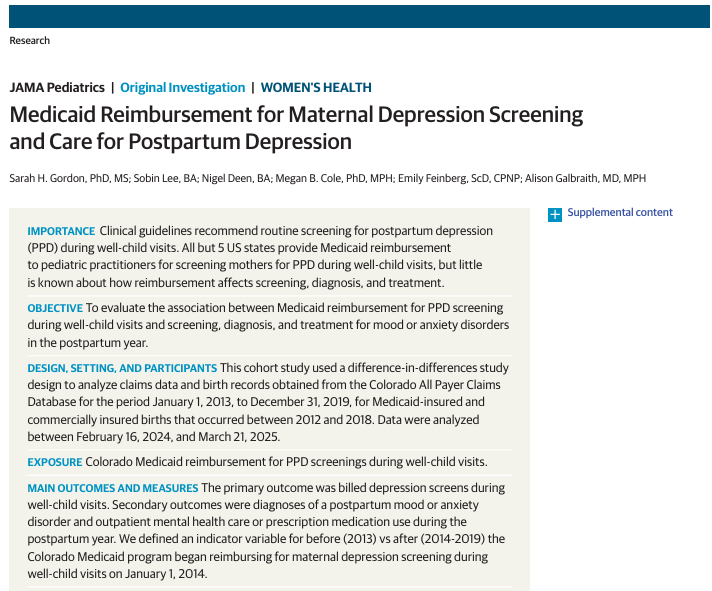
Clinical guidelines recommend routine screening for postpartum depression (PPD) during well-child visits. All but 5 US states provide Medicaid reimbursement to pediatric practitioners for screening mothers for PPD during well-child visits, but little is known about how reimbursement affects screening, diagnosis, and treatment. We evaluated the association between Medicaid reimbursement for PPD screening during well-child visits and screening, diagnosis, and treatment for mood or anxiety disorders in the postpartum year. Using a difference-in-differences study design and the Colorado All Payer Claims Database from 2013-2019, we compared Medicaid-insured and commercially insured births before and after Colorado’s Medicaid program began reimbursing for PPD screenings in well-child visits in January of 2014. In adjusted difference-in-differences models, reimbursement for maternal depression screening during well-child visits among Medicaid-insured mothers was associated with a 9.60–percentage point (ppt) (95% CI, 9.10-10.00 ppt) increase in the probability of billed depression screens during well-child visits (P < .001), a 2.5-ppt (95% CI, 1.40-3.50 ppt) increase in the probability of being diagnosed with a postpartum mood or anxiety disorder, a 3.3-ppt (95% CI, −4.60 to 2.00 ppt) decrease in prescription medication (P < .001), and a 3.3-ppt (95% CI, 2.50-4.10 ppt) increase in any outpatient mental health treatment (P < .001) compared with mothers who had commercial insurance. The findings of this cohort study suggest that Medicaid reimbursement for PPD screening during well-child visits may increase rates of detection, postpartum mood or anxiety disorder diagnoses, and outpatient treatment among mothers in the postpartum year. Insurance reimbursement for PPD screenings during well-child visits appears to be a promising policy strategy; however, additional interventions may be needed to address barriers to conducting screenings and referrals in pediatric settings and accessing postpartum mental health treatment.
Gordon SH, Lee S, Steenland MW, Deen N, Feinberg E. Extended Postpartum Medicaid In Colorado Associated With Increased Treatment For Perinatal Mood And Anxiety Disorders. Health Aff (Millwood). 2024 Apr;43(4):523-531.
Perinatal mood and anxiety disorders (PMAD), a leading cause of perinatal morbidity and mortality, affect approximately one in seven births in the US. To understand whether extending pregnancy-related Medicaid eligibility from sixty days to twelve months may increase the use of mental health care among low-income postpartum people, we measured the effect of retaining Medicaid as a low-income adult on mental health treatment in the postpartum year, using a “fuzzy” regression discontinuity design and linked all-payer claims data, birth records, and income data from Colorado from the period 2014–19. Relative to enrolling in commercial insurance, retaining postpartum Medicaid enrollment was associated with a 20.5-percentage-point increase in any use of prescription medication or outpatient mental health treatment, a 16.0-percentage-point increase in any use of prescription medication only, and a 7.3-percentage-point increase in any use of outpatient mental health treatment only. Retaining postpartum Medicaid enrollment was also associated with $40.84 lower out-of-pocket spending per outpatient mental health care visit and $3.24 lower spending per prescription medication for anxiety or depression compared with switching to commercial insurance. Findings suggest that extending postpartum Medicaid eligibility may be associated with higher levels of PMAD treatment among the low-income postpartum population.
Gordon SH, Chen L, DeLew N, Sommers BD. COVID-19 Medicaid Continuous Enrollment Provision Yielded Gains In Postpartum Continuity Of Coverage. Health Aff (Millwood). 2024 Mar;43(3):336-343.
The Medicaid continuous enrollment provision mandated by the Families First Coronavirus Response Act of 2020 effectively prohibited the termination of enrollees from Medicaid during the COVID-19 public health emergency, including people enrolled in Medicaid during pregnancy. Using data from the Transformed Medicaid Statistical Information System, we found that the rate of continuous Medicaid enrollment during the twelve months postpartum increased from 59.3 percent for births during March-December 2018 to 90.7 percent for births during March-December 2020, when the public health emergency was in effect. This corresponds to approximately 430,000 fewer people losing Medicaid coverage after pregnancy and an average of more than 2.5 months of additional postpartum enrollment. These findings indicate that states that have extended or that plan to extend pregnancy-related Medicaid eligibility in the postpartum year are likely to experience significant gains in continuity of coverage.
Admon LK, Auty SG, Daw JR, Kozhimannil KB, Declercq ER, Wang N, Gordon SH. State Variation in Severe Maternal Morbidity Among Individuals With Medicaid Insurance. Obstet Gynecol. 2023 May 1;141(5):877-885.
Objective: To measure variation in delivery-related severe maternal morbidity (SMM) among individuals with Medicaid insurance by state and by race and ethnicity across and within states.
Methods: We conducted a pooled, cross-sectional analysis of the 2016-2018 TAF (Transformed Medicaid Statistical Information System Analytic Files). We measured overall and state-level rates of SMM without blood transfusion for all individuals with Medicaid insurance with live births in 49 states and Washington, DC. We also examined SMM rates among non-Hispanic Black and non-Hispanic White individuals with Medicaid insurance in a subgroup of 27 states (and Washington, DC). We generated unadjusted rates of composite SMM and the individual indicators of SMM that comprised the composite. Rate differences and rate ratios were calculated to compare SMM rates for non-Hispanic Black and non-Hispanic White individuals with Medicaid insurance.
Results: The overall rate of SMM without blood transfusion was 146.2 (95% CI 145.1-147.3) per 10,000 deliveries (N=4,807,143). Rates of SMM ranged nearly threefold, from 80.3 (95% CI 71.4-89.2) per 10,000 deliveries in Utah to 210.4 (95% CI 184.6-236.1) per 10,000 deliveries in Washington, DC. Non-Hispanic Black individuals with Medicaid insurance (n=629,774) experienced a higher overall rate of SMM (212.3, 95% CI 208.7-215.9) compared with non-Hispanic White individuals with Medicaid insurance (n=1,051,459); (125.3, 95% CI 123.2-127.4) per 10,000 deliveries (rate difference 87.0 [95% CI 82.8-91.2]/10,000 deliveries; rate ratio 1.7 [95% CI 1.7-1.7]). The leading individual indicator of SMM among all individuals with Medicaid insurance was eclampsia, although the leading indicators varied across states and by race and ethnicity. Many states were concordant in leading indicators among the overall, non-Hispanic Black, and non-Hispanic White populations (ie, in Oklahoma sepsis was the leading indicator for all three). Most states, however, were discordant in leading indicators across the three groups (ie, in Texas eclampsia was the leading indicator overall, pulmonary edema or acute heart failure was the leading indicator among the non-Hispanic Black population, and sepsis was the leading indicator among the non-Hispanic White population).
Conclusion: Interventions aimed at reducing SMM and, ultimately, mortality among individuals with Medicaid insurance may benefit from the data generated from this study, which highlights states that have the greatest burden of SMM, the differences in rates among non-Hispanic Black populations compared with non-Hispanic White populations, and the leading indicators of SMM overall, by state, and by race and ethnicity.
 Sarah H. Gordon, PhD